Wood joints fall into four families: simple joints like the butt, miter, lap and rabbet, groove joints like the dado and tongue and groove, interlocking joints like the mortise and tenon, dovetail and box joint, and reinforced joints like the dowel, biscuit and pocket hole. Joint strength comes from face-grain glue surface and mechanical interlock.
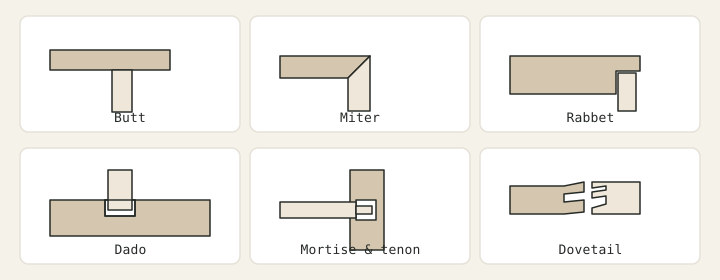
Almost every joint in a furniture project is a member of one of those families, and most builds mix several of them. A bookcase might use dados for the shelves, rabbets for the back, and edge joints for the sides. A drawer might use dovetails at the front and a groove for the bottom. Knowing what each joint is actually good at, and what makes it fail, is the fastest way to choose well instead of defaulting to whatever joint you have cut before.
The main joints at a glance
| Joint | Structure | What it resists | Typical uses |
|---|---|---|---|
| Butt | End of one board against face or edge of another | Little, relies on glue or fasteners | Rough framing, boxes with reinforcement |
| Miter | Two mating parts cut at complementary angles, usually 45 degrees | Little alone, better with a spline or key | Picture frames, trim, box corners |
| Lap | Half the thickness removed from each part where they cross | Racking in frames | Face frames, grids, stretchers |
| Rabbet | L-shaped step along an edge or end | Adds glue area and self-alignment | Box corners, back panels, drawer bottoms |
| Dado | Flat-bottomed channel cut across the grain | Vertical load and racking | Shelves, cabinet carcasses, dividers |
| Groove | Same channel as a dado, cut with the grain | Panel retention | Drawer bottoms, frame-and-panel work |
| Tongue and groove | Tongue on one edge fitting a groove on the mating edge | Alignment and cupping in panels | Edge-glued tops, flooring, paneling |
| Mortise and tenon | Tongue (tenon) fitted into a cavity (mortise) | Racking and twist, the strongest frame joint | Table legs to aprons, door frames, chairs |
| Bridle | Open mortise, like a fork, gripping a tenon | Racking, slightly weaker than a closed mortise | Frame corners, quick joinery |
| Dovetail | Trapezoidal tails and pins that interlock | Pull-apart in one direction, without glue or fasteners | Drawer fronts, boxes, carcass corners |
| Box or finger | Square pins and slots that interlock | Pull-apart with glue, large glue area | Box corners, drawers, carcasses |
| Sliding dovetail | Tapered dovetail tongue sliding into a matching channel | Pull-apart plus vertical load | Shelves into carcass sides, batten joints |
| Dowel | Round pins bridging the joint line | Moderate shear, good alignment | Edge joints, butt joint reinforcement |
| Biscuit | Compressed oval wafer in matching slots | Mostly alignment, modest strength | Panel glue-ups, miters, alignment aid |
| Loose tenon or Domino | Separate tenon in two mating mortises | Similar to a true mortise and tenon | Frame joints, fast furniture joinery |
| Pocket hole | Screw driven at a shallow angle into a stepped hole | Good in compression, weaker in tension | Face frames, carcass assembly, quick builds |
| Spline | Thin strip bridging a groove in both parts | Depends on the host joint, usually a miter | Reinforcing miters, decorative keys |
Simple joints
Butt joint
The butt joint is the end of one board placed flat against the face or edge of another, held by glue, nails, screws or some combination. It is the fastest joint to make and the weakest one to rely on, because glue bonds poorly to end grain. End grain acts like a bundle of straws: it wicks the glue in and leaves little on the surface, and any load that tries to pull the joint apart has only that weak glue line holding it.
A butt joint still has its place. In rough framing, shop furniture and hidden blocking it is perfectly adequate when reinforced, and it is the right joint where nothing will ever stress it. The reinforcing matters more than the joint: a butt joint glued and screwed, or glued and pegged with dowels, becomes a different animal. Screws driven into end grain hold far less than screws driven across the grain, which the USDA Forest Products Laboratory documents in its fastener data: withdrawal resistance along the grain is a fraction of the resistance across it, which is why a screw alone is never the answer in a load-bearing butt joint (Wood Handbook, chapter 8).
Miter joint
A miter is a butt joint cut at an angle, almost always 45 degrees so two parts form a 90-degree corner. It hides the end grain and lets grain or a profile wrap around the corner, which is why it dominates picture frames, casing and box work where the corner is visible. Structurally it is still a butt joint: mostly end grain, little glue strength, easy to slide out of alignment during clamping. That is why miters nearly always get a spline, a set of keys, biscuits or dominoes. The compound miter calculator handles the angle math when the corner is not a simple 90 degrees.
Lap joint
In a lap joint, half the thickness of each part is removed where they overlap, so the two parts sit flush after assembly. The reward is real: the glue faces are now face grain to face grain, which is the strongest glue bond wood can make, and the overlapping shoulders resist racking. Half-laps show up in face frames, stretcher grids and door frames. The weak point is that each part is only half thickness at the joint, so a lap trade stiffness for simplicity. A cross lap is the same idea cut in the middle of both parts, the classic joint for egg-crate dividers.
Rabbet joint
A rabbet is an L-shaped step cut along the edge or end of a board. It does three jobs at once: it doubles the glue surface compared to a butt joint, it locates the mating part so the assembly almost squares itself, and it hides the joint line by moving it off the corner. Rabbets are the standard way to recess a back panel or a drawer bottom into a carcass, and a rabbet on each corner of a box corner is a modest but real upgrade over a plain butt joint. Cut them with a table saw, a router with a rabbeting bit, or a shoulder plane.
Groove joints
Dado
A dado is a flat-bottomed channel cut across the grain into the face of a board, sized to accept the end or edge of a mating part. It is the workhorse joint of casework: shelves sit in dados, cabinet sides take dados for fixed shelves and dividers, and a dado captures a part so firmly that the joint resists both load and racking before glue is even applied. Because the mating part bears on the bottom and walls of the channel, a dado carries weight far better than any surface joint. The full method, including how a dado differs from a groove and a rabbet and how to cut one on a table saw or router, is in the dado joint guide, and the term is defined in the glossary entry for dado.
Groove
A groove is the same channel as a dado but cut with the grain instead of across it. The distinction matters because the two behave differently under load: a dado across the grain supports a shelf, while a groove along the grain usually holds a panel. Drawer sides get a groove for the drawer bottom. Frame-and-panel doors get a groove for the floating panel, and that panel must float, because solid wood expands and contracts across its width with humidity while the frame does not.
Tongue and groove
Tongue and groove pairs a groove in one edge with a matching tongue on the other. It is the standard joint for joining boards edge to edge into a wider panel, for flooring, and for paneling, because it aligns faces automatically and leaves a strong face-grain glue surface. In a tabletop glue-up the joint adds alignment more than strength: a well-milled plain edge, glued, is already stronger than the wood around it.
Sliding dovetail
A sliding dovetail is a tapered tongue with dovetail-shaped sides that slides into a matching dovetail channel cut across the grain. It combines the load support of a dado with the mechanical lock of a dovetail, so it holds a shelf or a divider without any fastener at all. The taper seats itself as the parts are driven home, which makes it self-tightening. It is slower to cut than a dado and unforgiving to fit, so it tends to appear in casework that justifies the effort.
Interlocking joints
Mortise and tenon
The mortise and tenon is the default joint of furniture frames. A tenon, a tongue formed on the end of one part, fits into a mortise, a rectangular cavity cut into the mating part. Its strength comes from glue surface: a tenon presents face grain on four sides, which is why a well-fitted mortise and tenon in a chair or table leg joint outlives the wood around it. Variants cover nearly every situation: through tenons that show on the far side, blind tenons that stop inside the mortise, wedged through tenons that lock mechanically, and haunched tenons that keep a groove open for a panel. Loose-tenon systems cut matching mortises in both parts and drop in a separate tenon, trading a little strength for a lot of speed. The mortise and tenon glossary entry covers the terminology in more detail.
Bridle joint
A bridle joint is a mortise and tenon with the mortise opened at the end, so the cavity becomes a fork that grips the tenon on three sides. It is easier to cut because there is no closed cavity to chop, and it still resists racking well, though it is weaker in pull-apart than a true closed mortise. Frame corners and stretcher work use it where the open slot is not objectionable.
Dovetail
Dovetails are trapezoidal tails on one board that interlock with matching pins on the other. The geometry does what glue cannot: the joint cannot be pulled apart in one direction even with no glue and no fasteners, which is why a through-dovetail drawer still holds together after a century of pulling. Through dovetails show the interlocking pattern on both faces; half-blind dovetails hide it on the show face, the standard for drawer fronts; sliding dovetails carry it into casework as described above. Spacing the tails and pins evenly is the part beginners find hardest to lay out, which is what the dovetail spacing calculator is for, and the cut itself is walked through in how to cut a dovetail joint. See also the glossary entry for dovetail.
Box joint
The box joint, also called the finger joint, interlocks square pins and slots instead of trapezoidal ones. It gives up the dovetail's mechanical lock, since the square fingers can slide apart, but it compensates with an enormous amount of face-grain glue surface, and once glued it is a genuinely strong corner. Its real advantage is repeatability: a simple jig on a table saw or router table produces identical pins across a whole set of parts, which is why box joints are the production choice for utility drawers and boxes. The box joint calculator works out the finger spacing so the joint starts and ends cleanly, and the box joint glossary entry defines the terminology.
Reinforced joints
Dowel
A dowel joint uses round pins, typically hardwood, glued into matching holes drilled across the joint line. Two or three dowels turn a weak butt joint into a respectable one by adding shear strength and, more importantly, alignment. Dowels also reinforce edge joints in panels, where they keep faces flush during clamping. Precision is everything: a dowel hole drilled 1/16 inch off makes assembly worse, not better, which is why doweling jigs exist.
Biscuit
A biscuit is a thin, compressed oval of beechwood inserted into slots cut by a plate joiner in both parts. The biscuit swells with glue moisture and locks into its slot. Honest assessment: biscuit joints add alignment far more than strength, and testing has repeatedly shown the biscuit itself contributes little pull-apart resistance. Use biscuits to keep a panel glue-up flat or a miter registered, not as the structural element of a load-bearing joint.
Loose tenon and Domino
A loose tenon is a separate tenon glued into mortises cut in both mating parts, and the Festool Domino is the best-known dedicated machine for cutting those mortises. The result behaves like a true mortise and tenon because that is exactly what it is, built backwards. For hobbyists without a Domino machine, shop-made loose tenons cut with a router and a simple jig deliver the same joint geometry at the cost of setup time.
Pocket hole
A pocket-hole joint drives a self-tapping screw at a shallow angle, typically about 15 degrees, through a stepped hole drilled into the back of one part and into the face grain of the mating part. It is fast, needs no clamping while the glue sets, and produces a serviceable joint in minutes. The honest limits: pocket screws hold well in compression and shear but are mediocre in tension, the angled screw can pull parts slightly out of alignment if the face is not clamped, and the holes show unless they are hidden on the inside or plugged. Face frames and cabinet carcasses are its home territory. Fine furniture is not.
Spline
A spline is a thin strip of wood that bridges a groove cut into both parts of a joint, usually a miter. It converts the miter's weak end-grain glue faces into long-grain glue faces on both walls of the groove. A spline can be hidden inside the joint or left exposed as a contrasting key, which turns a reinforcement into a design detail.
How much strength do you actually need
Joint strength is not a single ladder. Three things determine whether a joint survives: the direction of the load, the glue surface it offers, and whether the parts interlock. A dado under a shelf carries a vertical load forever because the weight bears on wood, not glue. A dovetail on a drawer front resists a pulling load because the geometry locks. A mortise and tenon resists racking because a tenon cannot rotate inside a fitted cavity. Match the joint to the load first, then worry about elegance.
The second rule is grain direction. Glue bonds long grain to long grain strongly and end grain to anything weakly, which is why nearly every strong joint is a way of converting end-grain contact into long-grain contact. Mechanical fasteners follow the same physics: the Forest Products Laboratory's fastener tables show withdrawal resistance for screws and nails is highest across the grain and lowest pulling straight out of end grain (Wood Handbook, chapter 8). Species matters too: dense hardwoods such as hard maple hold tenons, threads and small joinery crisper than softwoods, which is part of why maple turns up in workbenches and butcher blocks.
Choosing a joint for the build
The practical version of this page is a short table keyed to the part you are building.
| Part of the build | Joint to reach for | Reasonable alternative |
|---|---|---|
| Drawer front to side | Half-blind dovetail | Lock rabbet or box joint; pocket hole for utility drawers only |
| Shelf into a carcass | Dado | Sliding dovetail where the shelf must lock without fasteners |
| Table leg to apron | Mortise and tenon | Loose tenon if machining the joint is easier than chopping it |
| Face frame | Pocket hole | Mortise and tenon or half-lap for exposed work |
| Picture frame | Miter with a spline | Miter with keys or biscuits |
| Box corner | Box joint or dovetail | Rabbet for utility boxes |
| Panel edge to edge | Plain glued edge, biscuits or dowels for alignment | Tongue and groove when alignment is the problem |
| Drawer bottom | Groove in the drawer sides | Let the bottom float so it can move with humidity |
The next step
Pick the joint the build needs, then make the layout do the work. For dovetails and box joints the spacing math is the hard part, and the dovetail spacing calculator and box joint calculator generate the numbers directly. The dado guide and the dovetail cutting guide cover the two joints this pillar points at most often, and the glossary defines each term as you run into it.